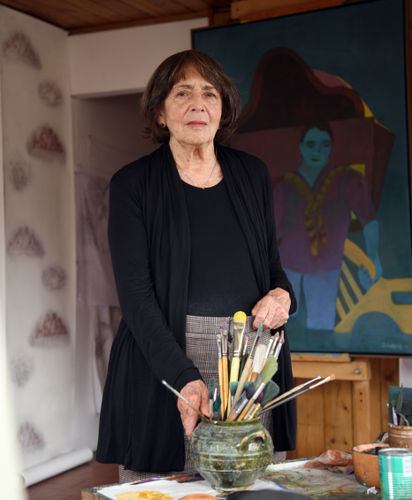
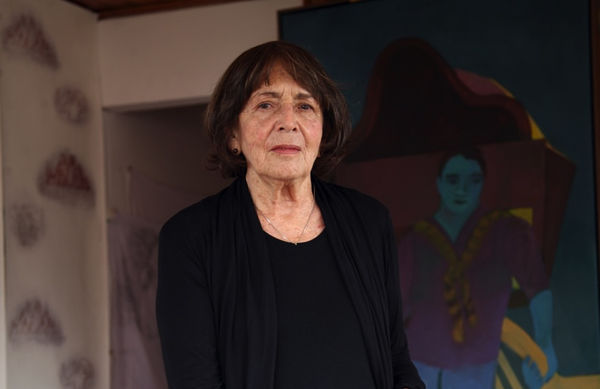
Over her six-decade career, Beatriz González developed a strong artistic vocabulary that makes her one of Colombia's most influential artists today. Since the beginning of her career, her works have been interwoven with the reality of her home country, which is marked by instability, corruption, and violence.
Through her paintings, drawings, and sculptures, Beatriz González picked out the often tragic moments of this troubled era, acting as a contemporary witness. Constant armed conflicts, including a ten-year civil war (1948–1958) and then the 52-year armed conflict between the Colombian state and the guerrilla movement led by the FARC (1964–2016), had a lasting impact on her perception of society. A controversial choice of subjects, which in the first two decades of her artistic practice, starting from the early 1960s, she approached through a critical sense of humor and irony. The press was of vital importance to her work, as Beatriz González collected images from scandal sheets and advertisements as substantial sources for her thematic remakes. She liked to “start from something that already existed,” as she stated: a graphic referent, a print, filtering it through a creative process. The modesty of Mrs González‘s technique tended to mislead the observer, giving her artwork a seemingly light appearance: vital, bold colors and irrational spaces for very concrete and serious subjects. Her choice of color and technique was original and very related to the country. It was the burgundy, blue, green, orange, and purple—colors of the Colombian countryside, as she experienced them in the architecture of Bucaramanga as a child.
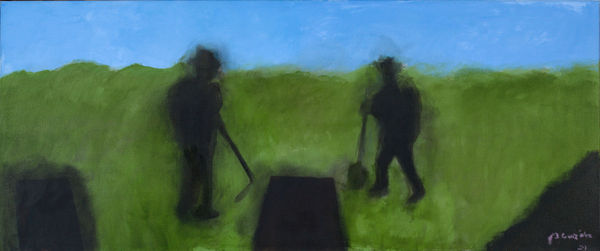
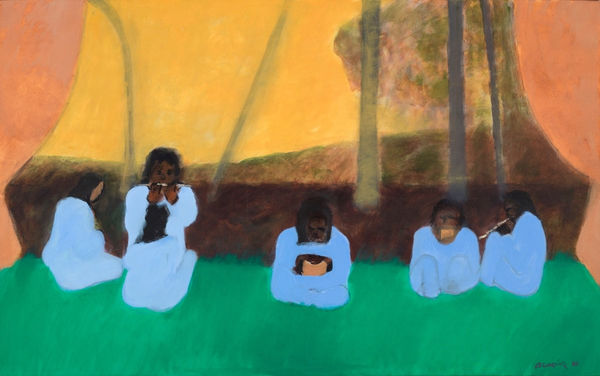
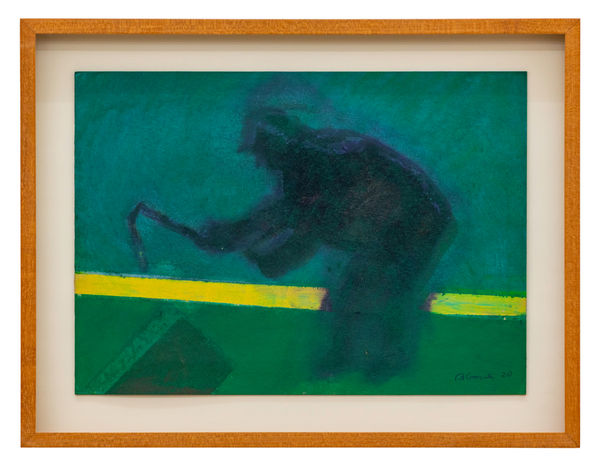
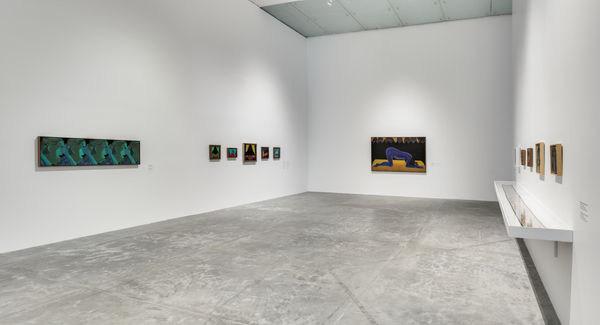
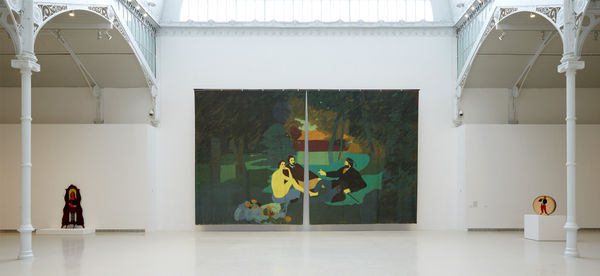
Since 2016, Beatriz González focused on a series of subjects around the politically charged figure of collective mourning, which had increasingly found their way into her work over the past twenty years. In the context of different narratives, the figure appeared as an abstracted black silhouette or as an allegory with simplified female features and ran like a connecting thread through the works in the exhibition. Simple outlines and generously applied areas of color in rich violet, green, earthy red, or mustard yellow dominated the composition. What appeared at first glance to be an everyday rural scene was a subtle reappraisal of a series of tragic events that gained increasing attention in the national and global press since the signing of the peace.
In Beatriz González's work, it was an approach towards the truth that silently reminded the viewer to remember. Her motifs underwent a transformation as she reworked press photographs collected from newspapers, translating them into drawings and repeated patterns. Through this process of refinement, they acquired an iconic presence. Her art went beyond merely appropriating press clippings; it recontextualized them, offering a lens through which to perceive historical events and collective memory. Her paintings created a pictorial world that, only on closer inspection, spoke of the tragic losses. Each work was like a poetic metaphor for the emptiness left by the missing. As in almost all her series of works, the artist played with repetition. While the silhouettes in the individual works were repeated in new combinations each time, their outlines were reduced to such an extent that they almost became a geometric pattern, as a sort of alphabet. The principle of repetition was intensely heightened in the wallpaper.
Beatriz González exhibited widely in some of the world’s leading museums. In 2023, the Museo Universitario de Arte Contemporáneo (MUAC) in Mexico City presented a solo exhibition, which subsequently traveled to the De Pont Museum in Tilburg in 2024. In 2019, the Pérez Art Museum Miami (PAMM) and the Museum of Fine Arts, Houston (MFAH) co-organized a major retrospective. In 2017, the CAPC Bordeaux devoted a comprehensive solo exhibition to the artist, accompanied by a catalogue; the show later traveled to the Museo Reina Sofía in Madrid and Kunst-Werke in Berlin (2018). That same year, her works were also presented at Documenta 14. In 2015, her works were included in the landmark group exhibition The World Goes Pop at Tate Modern, London. An extensive interview with Mrs González was published in the volume Conversations in Colombia in 2015 by the art historian and curator Hans Ulrich Obrist.
Her works are held in major international collections, including the Museum of Modern Art, New York; Tate Modern, London; Museo Nacional Centro de Arte Reina Sofía, Madrid; Museo Nacional de Colombia, Bogotá; Museum of Fine Arts, Houston; and the De Pont Museum, Tilburg.
With the co-production between the Pinacoteca de São Paulo, the Barbican Centre in London, and the Astrup Fearnley Museet in Oslo, her landmark retrospective continues this trajectory, reaffirming her place as one of the most significant voices in contemporary art from Latin America.
Beatriz González died on 9 January 2026 at 93 years old in Bogotá, Colombia.
-
 Ángelus local (Local Angelus), 2021
 -
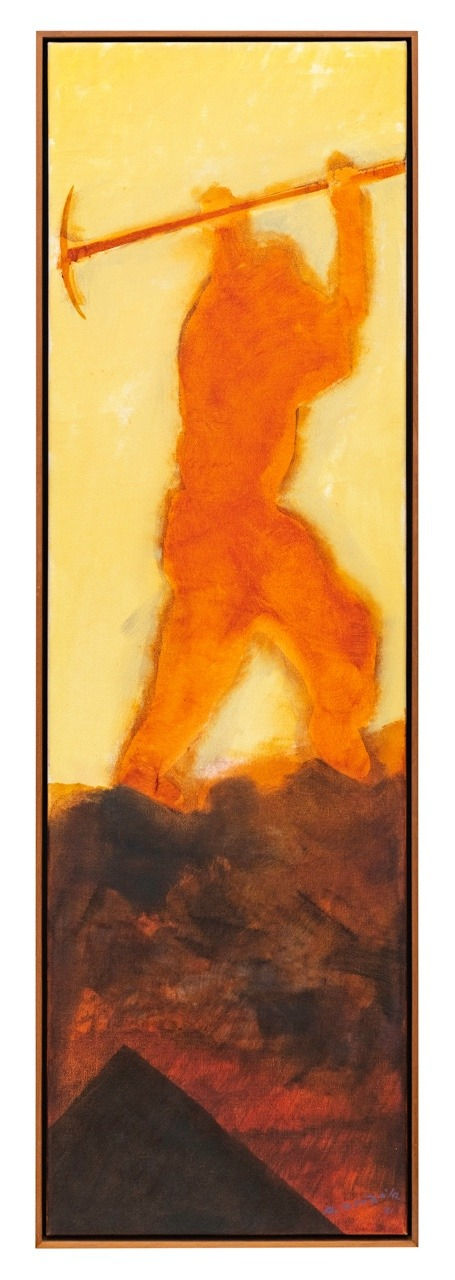
Cavar: presente de indicativo (To dig: present indicative), 2021
-
Duelo por desaparecidos (Mourning for the missing), 2021
-
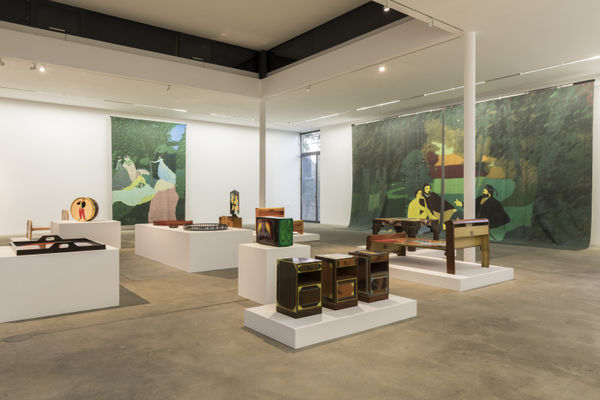
Papel de colgadura Panorámica agreste (Wild panorama wallpaper), 2021
-
Proyecto Telón de Guerra y Paz I - Guerra (War and Peace Curtain Project I - War), 2020
-
Proyecto Telón de Guerra y Paz II - Paz (War and Peace Curtain Project II - Peace), 2020
-
Estudio Cinta Amarilla III (Study Yellow Ribbon III), 2020
-
Enterrador de Barranca (Gravedigger of Barranca), 2019/ signed in 2021
-
Boceto paisajes elementales: Fuego en la Sierra (Sketch for elementary landscapes: Fire in the Sierra), 2017
-
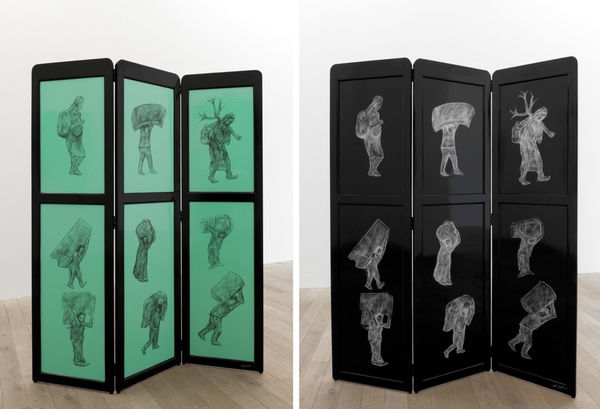
Desplazamiento anverso y reverso (Displacement recto and verso), 2017
-
Paisajes elementales: Tierra en Barranca (Elemental landscapes: Earth in Barranca), 2017
-
Desplazamiento vertical (Vertical displacement), 2016
-
Estudio de Enea (Study for Enea), 2016
-
Desplazamiento horizontal (Horizontal displacement), 2016
-
Zulía, Zulía, Zulía, 2015
-
Serie Pictografías Particulares, 2014
-
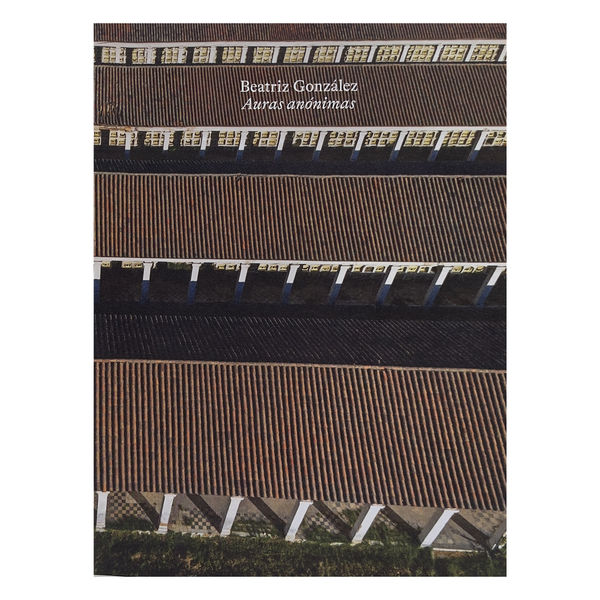
Auras Anónimas (Anonymous Auras), 2007-2009
-
Todos murieron carbonizados, 1999





-
Beatriz González
Barbican Art Gallery
London, UK
25 Feb - 10 May 2026Originally conceived and premiered at the Pinacoteca de São Paulo, the project now enters a new chapter in London. This progression from one of Latin America’s leading institutions to one...Read more -
Beatriz González
The Images in TransitPincacoteca de São Paulo, Brazil
30 Aug 2025 - 1 Feb 2026The Image in Transit is the first major retrospective of Beatriz González at the Pinacoteca de São Paulo. Featuring more than one hundred works dating from the 1960s to today,...Read more -
Beatriz González
War and Peace: A Poetics of GestureMUAC, Mexico
25 Nov 2023 - 30 Jun 2024BEATRIZ GONZÁLEZ War and Peace: A Poetics of Gesture MUAC - Museo Universitario Arte Contemporáneo Insurgentes Sur 3000 Centro Cultural Universitario Delegación Coyoacán C.P. 04510 Ciudad de México November 25,...Read more -
Group Show
The Other Side of the Mirror is HomeGalerie Peter Kilchmann
Zahnradstrasse, Zurich
1 Sep - 11 Oct 2023With works by Vlassis Caniaris, Willie Doherty, Beatriz González, Leiko Ikemura, Teresa Margolles, Dagoberto Rodríguez, Adrian Paci, Shirana Shahbazi in collaboration with Anne Morgenstern, Didier William and Artur Zmijewski.Read more -
Beatriz González
Bruma, FragmentosEspacio de Arte y Memoria, Bogotá, Colombia
13 Sep 2022 - 15 May 2023To celebrate the master Beatriz González, FRAGMENTOS, Espacio de Arte y Memoria, in alliance with the Museo de Arte UNAL, presents BRUMA, an exhibition that gathers her most recent artistic...Read more -
Beatriz González
FunebriaGalerie Peter Kilchmann, Rämistrasse, Zurich
28 Aug - 2 Oct 2021Central themes from her oeuvre, such as memory and Colombia's collective memory, will be explored and developed further in a broad range of techniques in the medium of painting. On...Read more -
Beatriz González
A RetrospectivePérez Art Museum Miami (PAMM), Miami, US
19 Apr - 1 Sep 2019.Read more -
Beatriz González
Retrospective 1965–2017KW Institute for Contemporary Art, Berlin, Germany
13 Oct 2018 - 6 Jan 2019Since then, González’ work has been concerned with everyday scenes, public protest rituals, and scenes of collective pain in her home country, Colombia. The artist broke with the anonymous, impersonal...Read more -
Beatriz González
Museo Nacional Centro de Arte Reina Sofia, Madrid, Spain 22 Mar - 2 Sep 2018González draws inspiration from the mass media, engaging in dialogue with popular narratives and formal painting, or appropriating press photographs, reinterpreting them through drawing, painting, graphic art and sculpture. Furthermore,...Read more -
Beatriz González
1965–2017Capc Musée d'art Contemporain de Bordeaux, Bordeaux, France
23 Nov 2017 - 25 Feb 2018In 1964, Beatriz González adopted a modus operandi that she would remain faithful to thereafter, turning an image from the Colombian press into a series of paintings. The archives she...Read more -
Beatriz González
Desplazamientos Forzados y Paisajes ElementalesGalerie Peter Kilchmann, Zahnradstrasse, Zurich
11 Jun - 28 Jul 2017Galerie Peter Kilchmann is pleased to present a solo exhibition of Colombian artist Beatriz González (b. 1938) in collaboration with the gallery Casas Riegner, Bogotá. Beatriz González lives and works...Read more






-
A Major Restrospective dedicated to Beatriz González opens on February 25 at Barbican Centre, London
Around 150 Works, Mostly Shown for the First Time in the UK January 30, 2026 Read more -
Beatriz González honored with International Award for Public Art 2024
Beatriz González received the Regional Grant Award in the Latin America category for her work Auras Anónimas (Anonymous Auras) November 29, 2024Beatriz González received the Regional Grant Award in the Latin America category at the sixth International Award for Public Art 2024, presented by the International...Read more



-

Beatriz González
Funebria, 2021 Publisher: Galerie Peter Kilchmann Read more -
Beatriz González
Auras Anónimas, 2020 Editor: La Oficina del Doctor - Casas Riegner Bogota Read more -
Beatriz González
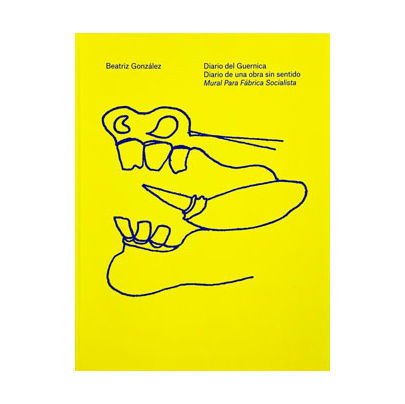
Diario del Guernica, 2018 Editor: Zulu Press, La Oficina del Doctor, Bogota/ Barcelona Read more -
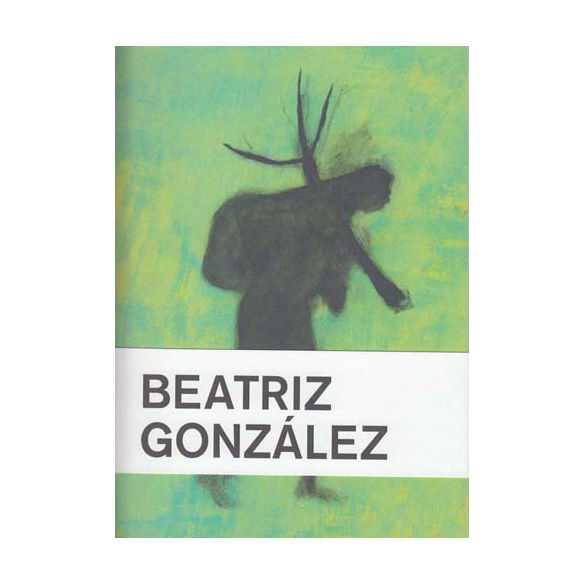
Beatriz González
Desplazamientos forzados y paisajes elementales, 2017 Author: José Ruiz Read more -
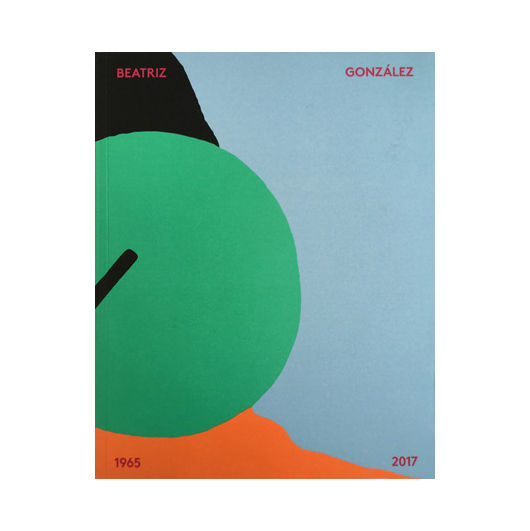
Beatriz González
1965 - 2017, 2017 Text: María Inés Rodríguez, Luis Pérez-Oramas, José Ruiz DíazEditor: CAPC Bordeaux, Reina Sofía Madrid, Kunst-Werke Berlin
Read more -

Beatriz González
Reiteraciones (1981-2015), 2015 Author: Paula Bossa, José Ruiz DiazEditor: Casas Riegner & La Oficina del Doctor, Bogota
Read more -
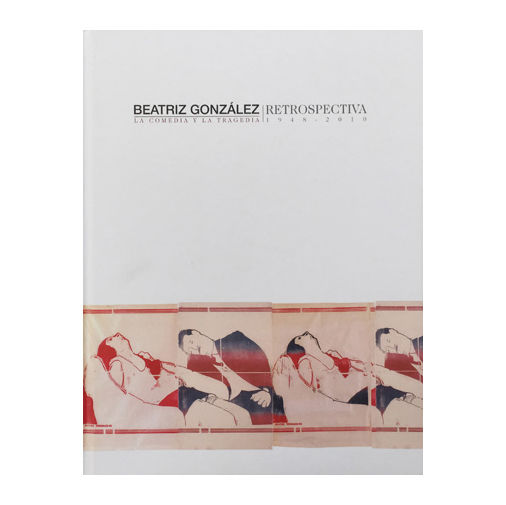
Beatriz González
La Comedia y la Tragedia, Retrospectiva (1948-2010), 2015 Author: Juliana Restrepo T. et al.Editor: Ediciones MAMM, Bogota
Read more


