-
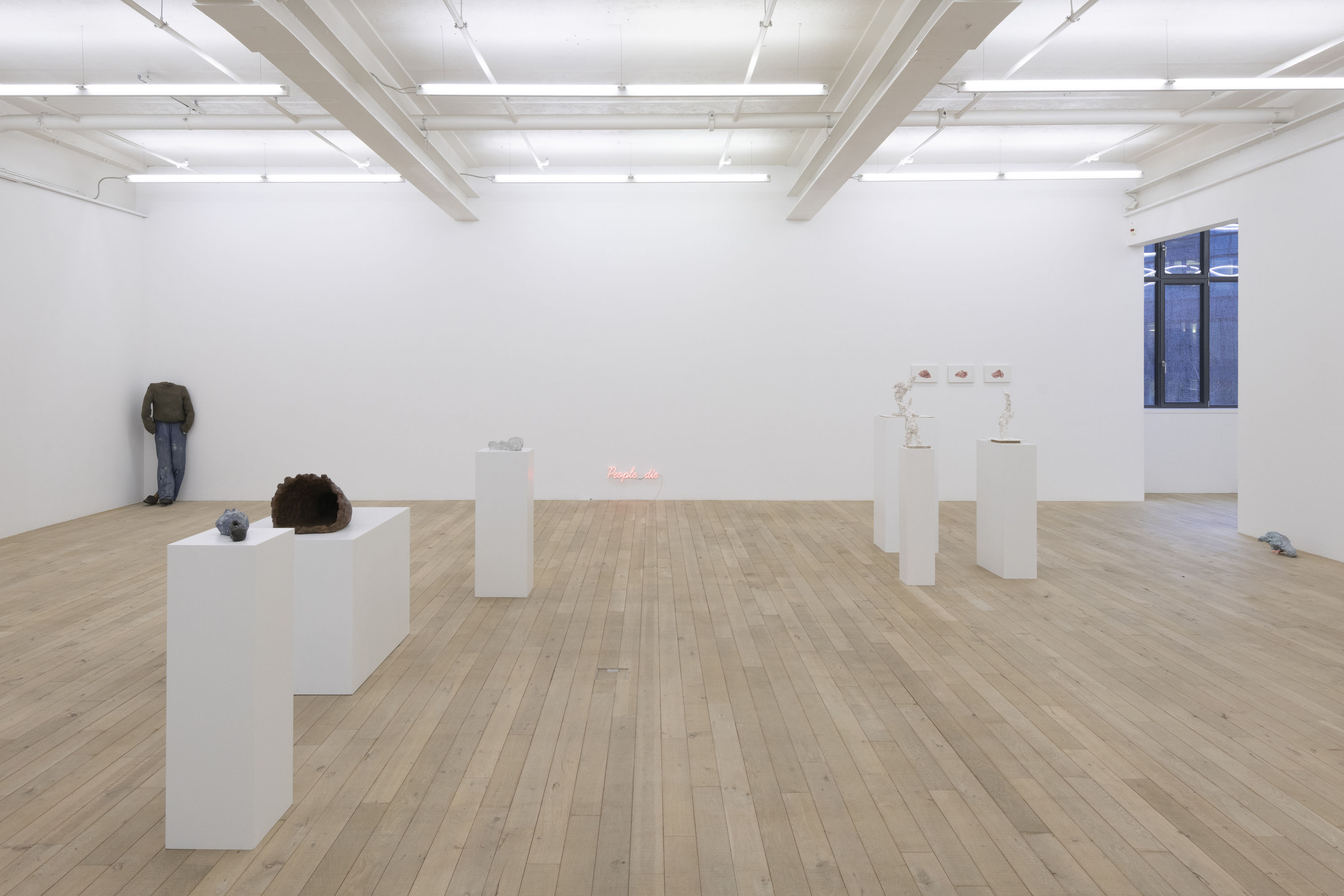
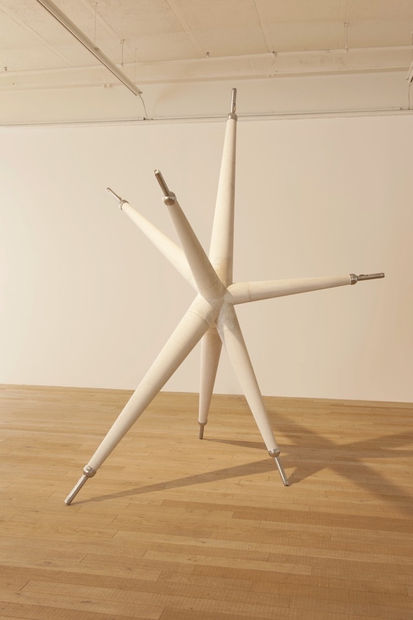
Galerie Peter Kilchmann is pleased to conclude the exhibition year at its premises on Zahnradstrasse with the group exhibition SKULPTUR HEUTE (SCULPTURE TODAY). Contributions from the following artists are on display: Francis Alÿs, Maja Bajević, Vlassis Caniaris, Los Carpinteros, Andriu Deplazes, Willy Doherty, Valérie Favre, Christoph Hänsli, Leiko Ikemura, Zilla Leutenegger, Jorge Macchi, Shirana Shahbazi, Tobias Spichtig, Didier William, Artur Żmijewski.
-
-
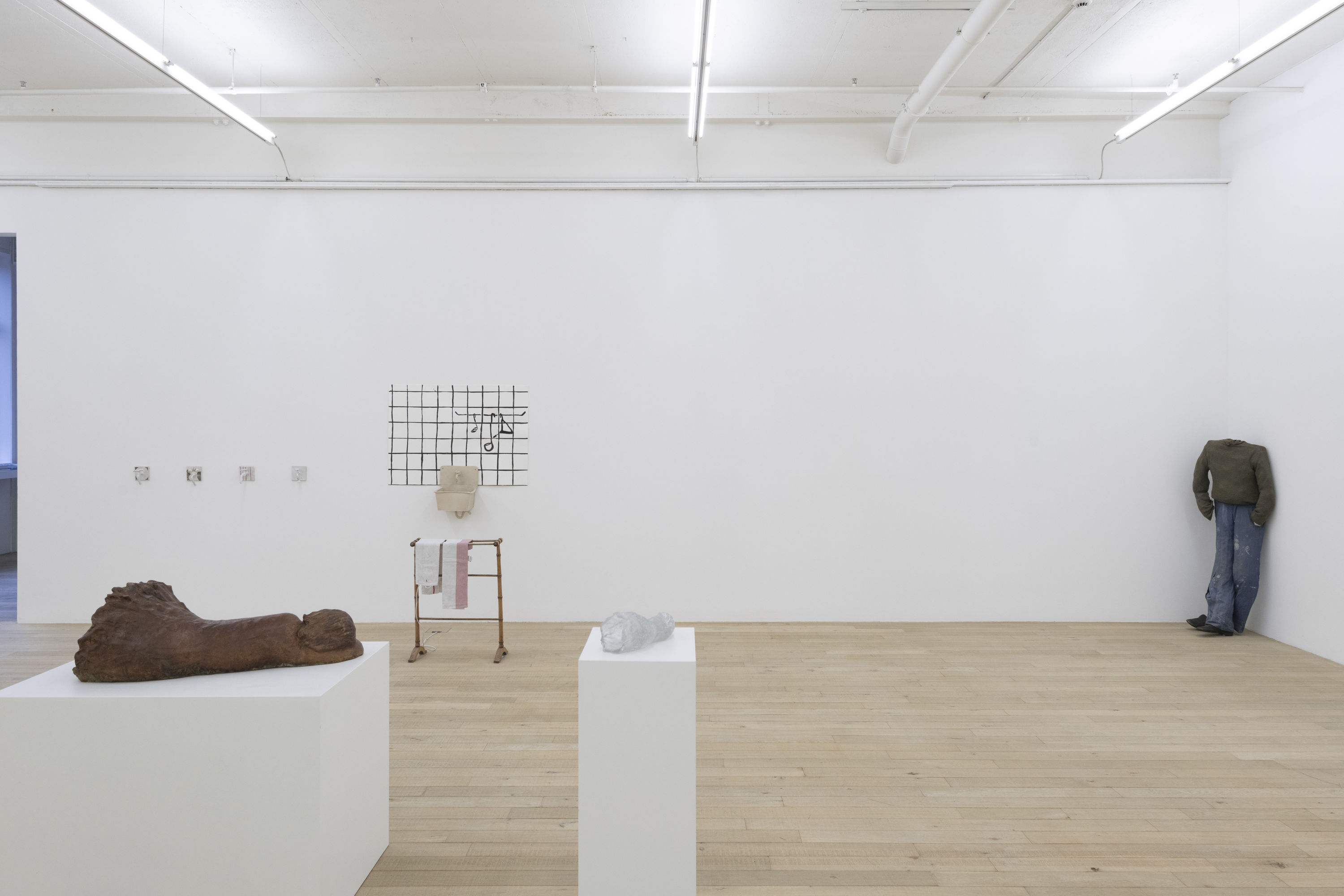
The exhibition opens with works by Zilla Leutenegger (*1968 in Zurich; lives and works in Zurich and Soazza): several small ceramic works and the new video installation Lavabobo (2025). In the latter, the video is only a fleeting moment—the focus lies on the sculptural presence of the work. On the wall, a grid of black lines on white paper can be seen, reminiscent of tiles, between which simple kitchen utensils are suggested. A small ceramic sink is mounted beneath, its hose continually releasing projected water droplets. From fragments of the everyday life, Zilla creates spaces out of memory. Lines, light, and materiality intersect: the drawing extends into the space, and the video becomes physically tangible. This generates a condensation in which time and perception merge—a subtle, playful shift of reality.
-
Leiko Ikemura (born in Tsu, Mie Prefecture, Japan; lives and works in Berlin) is represented by three reclining sculptures: Lying on the Lake (2017), Velvet Girl (2021/23), and Liegende (Reclining Figure) (2025). All three depict a girl lying on her side, rendered either in bronze or in glass. The figure embodies far more than an image of sleep. It conveys states of transition—between childhood and adulthood, repose and tension, enclosure and openness, the imaginary and the real. Through reduction and suggestion, the girl becomes a metaphor for existence—less an individual than a universal being. Ikemura is concerned with the question of “where we come from and how we might arrive in reality.” Depending on the light and time of day, the glass sculpture Velvet Girl, for instance, changes its color, shifting along a spectrum from pale grey to delicate pink, at times appearing soft as cotton and at others hard as stone.
-

-
-
-
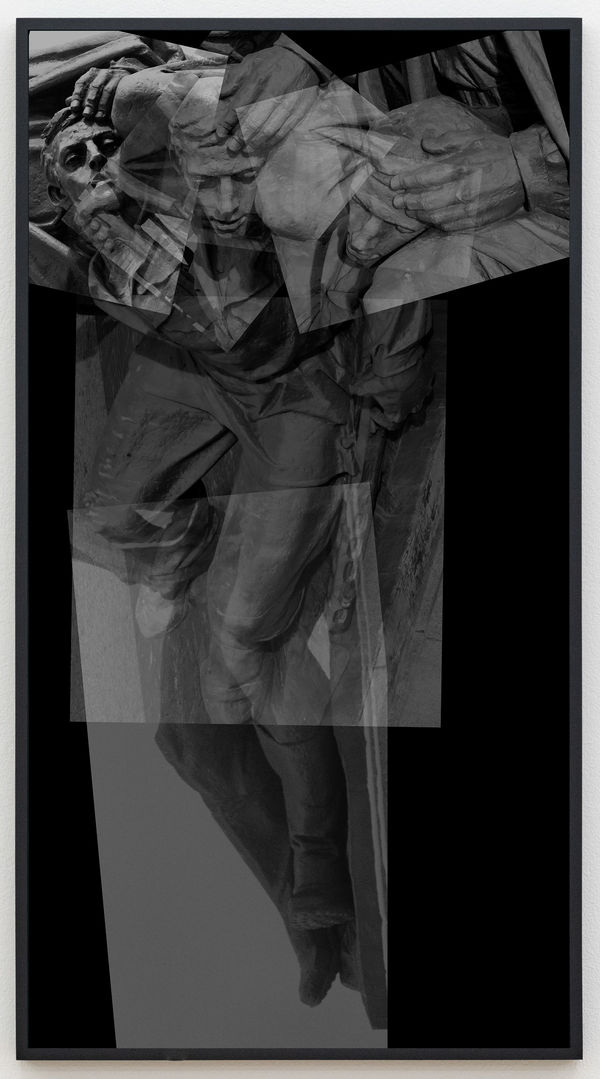
Artur Żmijewski (*1966 in Warsaw, where he lives and works) presents three black-and-white photographs from the series Red Army (2023). The works were taken by Żmijewski at the Soviet Military Cemetery in Warsaw and depict sections of the two sculptural groups Heroism and Sacrifice by the sculptors Jerzy Jarnuszkiewicz and Stanisław Lisowski, which form part of the conflict-laden monument honoring the Red Army. The artist has fragmentarily overlaid the details of the stone-carved figures, thereby detaching them from their site-specific context and imbuing them with a new layer of meaning.
-
-
The two sculptures Fuck Me, Please, Thank You, You’re Welcome (2025) and Me in the Studio (Bronze 1, 2025) by Tobias Spichtig (*1982, Sembach, Switzerland; lives and works in Zürich and Berlin) stand in a mystically ghostly manner on the right side of the room. The unusual combination of studio garments and diving fins arose by chance—through an attempt to stabilize the fragile, attenuated sculptures using elements from his atelier. The bronze sculpture, with a greenish patina, was produced by casting an original resin sculpture and then burning it out. This process of burnout imparts a tense verticality and a delicate transparency to the figure. It appears to emerge from the material while simultaneously detaching from it.
-
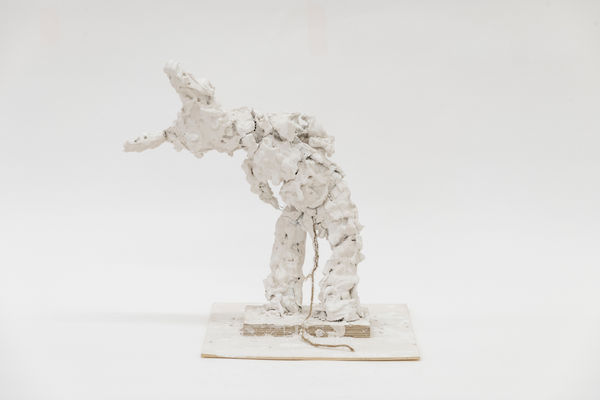
Three new fragile sculptures in white plaster by the artist Valérie Favre (*1959 in Switzerland; lives and works between Berlin and Neuchâtel) are on display. Each is titled Lapine univers rau (2025), yet they differ in size and form. Favre has brought her renowned alter ego from the Lapine Univers series, which she began in the early 2000s, literally from the two-dimensional plane into three-dimensional space.
-
A unifying element between the first and second rooms is formed by six bronze sculptures of pigeons by Andriu Deplazes (*1993 in Zürich; lives and works in Marseille and Zürich), each displayed individually or in pairs throughout the exhibition spaces: Taube mit Stummelbein (2025), Aufrechte Taube (2024), Hinkende Taube (2025), Taube blickt zurück (2024), Liegende Taube (2024), and Taube an Kante (2025). The pigeon, as a recurring motif in Deplazes’ work, reflects his engagement with nature and civilization and the relationship between humans and animals.
-
-
In the second exhibition room, viewers first encounter Camgun #69 (2008) and Camgun #73 (2008) by Francis Alÿs (*1959 in Antwerp; lives and works in Mexico). These assemblages of wooden guns and found film reels and spools hover on the boundary between camera and firearm. The acts of photographing and firing bullets are intrinsically linked—and here imbued with a subtle, underlying sense of humor. Each work is accompanied by a so-called instruction manual, framed and installed on the wall within the exhibition.
-
-
-
-
-
-
The third room is dedicated to the installation Gesture to Home (Group III, 2023) by Didier William (*1983, Port-au-Prince, Haiti; lives and works in Philadelphia). Installed against teal-colored walls are two paintings of cypress swamps, which serve as carriers of history. The evening sky glows in shades of orange and red in the background, casting yellow reflections on the reflective surface of the swamp. The tree trunks shimmer magically in vivid turquoise and orange. Two sculptures occupy the space, emerging from the cypress trunks: a single hand and a figure bending backward, as if attempting to free itself from its firmly rooted base. Both sculptures feature William’s characteristic black-and-white eyes, which gaze in all directions, transforming the viewers into the observed.
-
Didier William
Gesture to Home (Group III), 2024Installation with two paintings (acrylic on panel) and two sculptures (ink on carved epoxy resin, EPS, wood, and steel)
Paintings, each 269.2 x 152.4 cm (106 x 60 in.)
249.8 x 83.8 x 82.5 cm (98 3⁄8 x 33 x 32 1⁄2 in.)
96.5 x 41.3 x 41.3 cm (38 x 16 1⁄4 x 16 1⁄4 in.) -
With works by: Alÿs, Bajević, Caniaris, Los Carpinteros, Deplazes, Doherty, Favre, Hänsli, Ikemura, Leutenegger, Macchi, Modé, Shahbazi, Spichtig, William, and Zmijewski
Galerie Peter Kilchmann
Zahnradstrasse 21, Zurich, 4 November - 19 December 2025












Be the first to know updates about Galerie Peter Kilchmann
* denotes required fields
We will process the personal data you have supplied to communicate with you in accordance with our Privacy Policy. You can unsubscribe or change your preferences at any time by clicking the link in our emails.


Be the first to know updates about Galerie Peter Kilchmann
* denotes required fields
We will process the personal data you have supplied to communicate with you in accordance with our Privacy Policy. You can unsubscribe or change your preferences at any time by clicking the link in our emails.