-
It is freezing, but it is a good thingto step outside again: you can feel less alone in the night,with lights on here and therebetween the dark buildings and trees.Your own among them, somewhere.There must be thousands of peoplein this city who are dyingto welcome you into their small bolted rooms,to sit you down and tell youwhat has happened to their lives.And the night smells like snow.Walking home, for a momentyou almost believe you could start again.And an intense love rushes to your heart,and hope. It's unendurable, unendurable.Franz Wright, East Boston, 1996
-
-
Parallax Hotel. The café on the corner, the one we always go to. Matthias walks to my left. I adjust to his pace. The shops are fogged-up cubes. Outside, it is barely ten degrees, and already too warm. He presses his hand against the glass, leans forward to look through it, and talks about what we were waiting for when we came here.He would like the exhibition title to reflect this. Not only his work, but also the environment in which it came into being. I think he fears conditioning, that what he makes might only exist in a floating state, without roots or branches, nothing but a trunk. This is what happens when we forget the circumstances in which a work was created. I would never have been interested in art if it did not involve the artist. M. speaks of his “spiritual accomplices,” an expression I often hear him use to refer to the artists who inspire him: Joseph Cornell above all, then Curtis Cuffie and Isa Genzken, who work from what they see in the street. But also Californian assemblage artists such as Bruce Conner, and those who engage with inhabitants and with the city in its morphology, Gordon Matta-Clark or Gregor Schneider, for instance.
-
As we cross the same streets I walked alone the day before, I wonder whether the city has changed me. At times, I resent it for moving ahead without me. I watch it destroy and rebuild at full speed, demolish the buildings where I lived, displace people, shut down the bars where I danced with strangers. Does it even know my name? Cities are authentic and there is no present.Understanding where we are in space, where we position ourselves sensorially. Matthias speaks of this often: inscribing oneself in the city, in the urban fabric. As he gathers objects from the places he visits, he sometimes wonders where his place is, if such a place exists at all, among architectures.
-

-
-
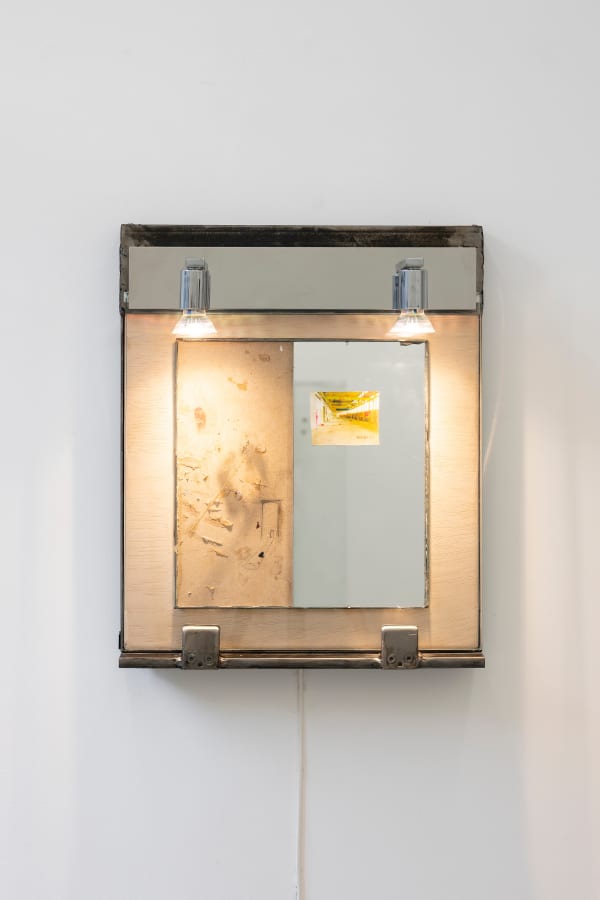
toujours là (prehesion of the distant past) and inversion (miroir bohème) face one another. The use of transparent glass and a mirror evokes the bathroom, a common yet intimate place where one lays oneself bare. Watching my reflection in the small rectangular mirror, I remember all the bathrooms in this city where I told people I loved them for the first time. There must have been something strange in the air that day. In my memory, it was a feeling of safety, of certainty, that I have only felt intermittently, and that the city seems to have taken away from me now.M. tells me that when he conceived this piece, he could see his face taking on the shape of a warehouse, from spending so many nights there. He tells me it is not the first time his face has merged with a building in which he has spent time. Self-Observing-Paris.
-
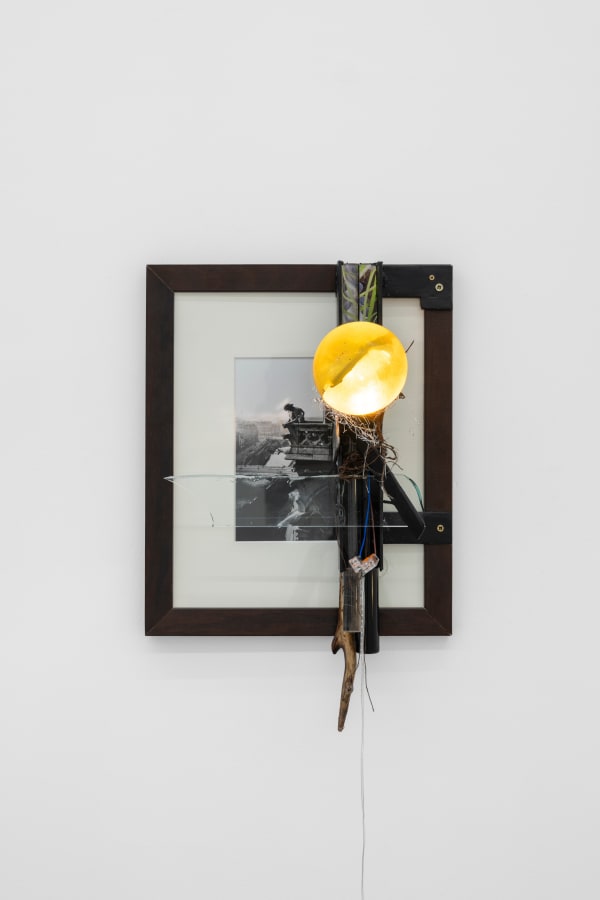
Matthias has been working from this city for seven years. The series of “Parisian views” is based on a set of frames and photographs found in an abandoned hotel near rue de Paris in Les Lilas. He composes from images of the city and revisits the romantic projection he carried when he moved to the capital. In these assemblages, he also incorporates photographs of the construction site behind his home, welded, painted and polished steel elements that recall electrical networks and other energy flows, as well as luminous spheres cast in rubber and filled with studio remnants, echoing the artist’s everyday life in his place of work. Like the city itself, and the different gazes cast upon it, gradually revealing new layers of understanding, Matthias’s assemblages grow denser, accumulating multiple strata. His practice is not solitary. Several materials used in the works presented in the exhibition come from places where others have lived their lives, such as Villa Schacher, a now-abandoned manor that once belonged to the medallist Albert de Jaeger. M. works in relation to past histories, entering in this way into dialogue with other lived experiences and different eras.
-
Project Space, Galerie Peter Kilchmann
11-13 rue des Arquebusiers, Paris
, 10 January - 27 February 2026






Be the first to know updates about Galerie Peter Kilchmann
* denotes required fields
We will process the personal data you have supplied to communicate with you in accordance with our Privacy Policy. You can unsubscribe or change your preferences at any time by clicking the link in our emails.

Be the first to know updates about Galerie Peter Kilchmann
* denotes required fields
We will process the personal data you have supplied to communicate with you in accordance with our Privacy Policy. You can unsubscribe or change your preferences at any time by clicking the link in our emails.