-
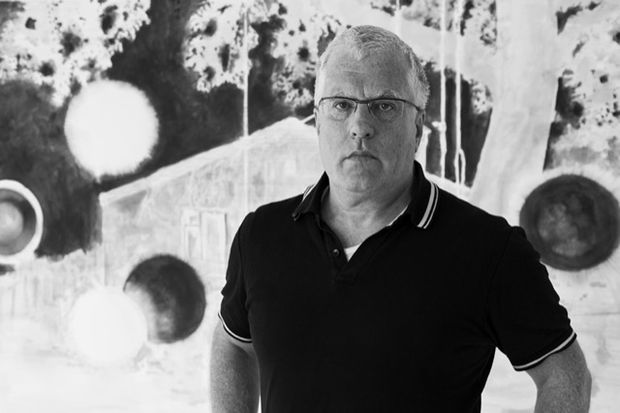
Galerie Peter Kilchmann is delighted to present La Cloche dans la Forêt (The Bell in the Grove), the fourth solo exhibition of Uwe Wittwer (b. 1954, Zürich, Switzerland, where he lives and works).
For this first exhibition in Paris, Wittwer presents a collection of oil paintings and watercolours inspired by works by great French masters such as Paul Cézanne, Henri Fantin-Latour, and Nicolas Poussin. He also continues previous series that explore characteristic themes of his work: historical events, ruins, portraits, and group scenes. This new set of works, alongside his very distinctive use of negative images, provides him with an opportunity to extend his research on the sensory reception of images. -
-
Since the 1980s, Uwe Wittwer has taken on the role of an image collector. His iconographic sources come from various places: the web, archives, historical photographs, family albums, and masterpieces from art history. This collection reveals a search for the “right” image - one that offers more than a simple representation of a subject. Wittwer first alters the images in the computer, collaging and retouching, playing with dislocation and even stripping down the images, dissecting the smallest details to give them a new dimension. The process has little to do with copying; painting becomes a tool of reincarnation. Wittwer bestows his subjects with a new materiality, imbuing them with colors, shades, and depth, thus transforming a known or overused image into a singular and sensory experience.
-
A first impression of chaos prevails in some of the works. The ruins of the cathedral of Ypres (Ruins of Ypres, 2025, oil on canvas, 130 x 110 cm), with a composition intertwining geometric elements and organic shapes, almost makes it seem as if the image is consuming itself. The ruins reappear, almost insistently. In contrast, Ruin, 2025 (oil on canvas, 80 x 90 cm), transports the viewer inside the building. Three fires occupy the foreground, while in the background, silhouettes appear, uncertain whether they are observing or provoking the disaster. The temporality remains indistinct, suspended. The ruins prompt reflection on the process of memory and how time becomes relative for those who immerse themselves in it. Within this landscape of ruins, the bell is heard in thought: an ancestral marker of the passage of hours, it structures collective life, announces events, gathers, and, in times of war, warns, mobilizes, and signals danger. In 1915, at Ypres, the German use of chlorine gas introduced a new weapon of unprecedented violence on the Western Front. Soldiers, unprotected against this gas, had to improvise warning signals; one can imagine that some bells, removed from churches, may have been placed at a distance from the trenches to signal the imminence of an attack. The painting The Bell in the Grove, 2025 (oil on canvas, 80 x 60 cm), transposes this role into a striking silence and isolation. The bell, set in a winter landscape, seems to resonate beyond its physical presence, carried by an invisible intention. In dialogue with the ruins of the Cathedral of Ypres, it embodies both the fragility of destroyed sites and the persistence of memory signals: a discreet witness, evoking vigilance, alertness, and the continuity of history through time.
-

While painting is no longer an informative tool today, it can still serve as a form of resistance to the constant influx of images we absorb. For Wittwer, it is an opportunity to slow down the gaze. It doesn’t document history; it places us face-to-face with it. His ruins or battle frescoes are not just remnants; they become sensitive surfaces. In front of them, it’s no longer simply about knowing, but about looking differently, about distancing oneself in order to better understand the present and approach it with knowledge.
-
Uwe Wittwer
Le jeune Pyrrhus d'après Poussin (The young Pyrrhus after Poussin / Der junge Pyrrhus nach Poussin), 2025The painting The Young Pyrrhus after Poussin, 2025 (oil on canvas, 195 x 340 cm), a monumental battle scene, depicts the flight of the young Pyrrhus, condensing a moment of transition where fate is decided in an instant. In Wittwer’s reinterpretation, the child’s figure no longer occupies the centre, but shifts to the left of the canvas. This displacement alters the initial balance of the scene, suggesting that the action continues off-screen, as if caught in its becoming. The gaze and duration are transformed, reactivating history in an open temporal context. -
-
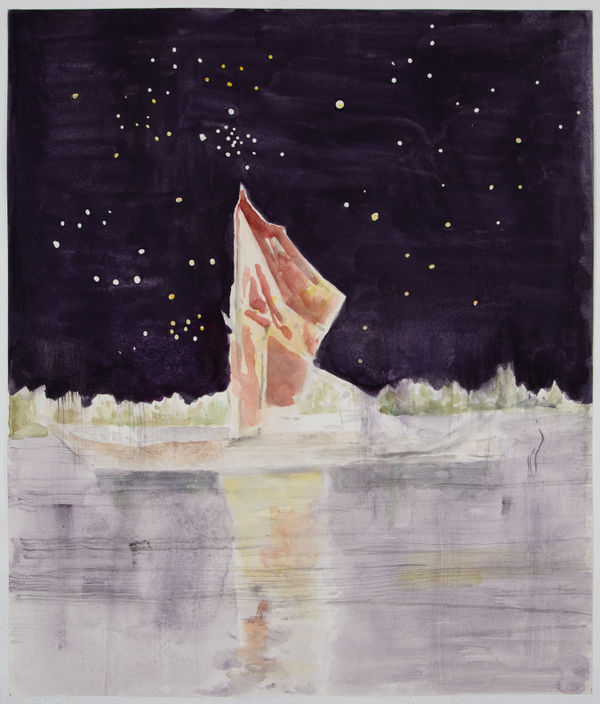
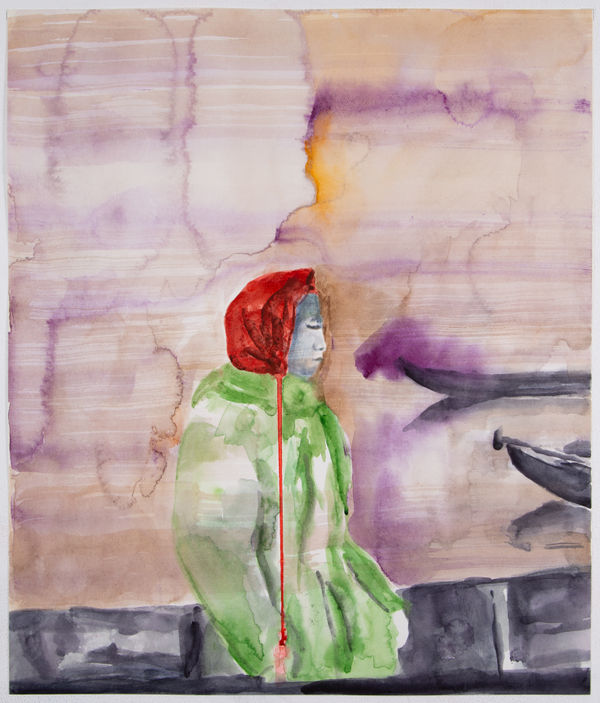
Moving through the exhibition, watercolors of portraits, drawn from Wittwer’s research of the photo archives of the Basel Mission and the Pitt Rivers Foundation, interact with maritime scenes - a subject he has explored since the 1980s. For Wittwer, “watercolor allows for thinking in the shadows”: it opens spaces for absence and intensity, transforming the relationship to the visible and the invisible - memory and emotions. The fluidity of the medium and the porosity of the paper reflect the passage of time, suspending the image like a substitute for presence. Circular forms—holes, bursts, perhaps stars—animate the compositions.
-
-
-
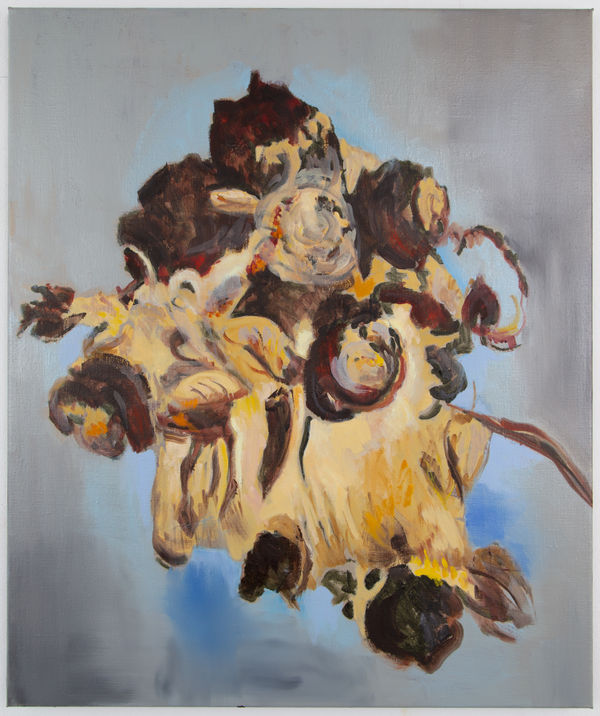
In the final room of the gallery, still lifes based on Fantin-Latour (Still Life Negative after Fantin-Latour, 2025, oil on canvas) seem to carry both existence and death simultaneously. By rendering them in negative, Wittwer gives them an almost dramatic presence. His flowers, the main characters in a final act, deliver an especially intense and brilliant performance, reminding the viewer that once the curtains fall, the spectacle will only exist in memory. They are then dressed in specially crafted costumes and colors to stimulate and help the memory imprint itself in the space of remembrance, a fictional place, to be sure, but one where sensations and emotions exist, work, and eventually contribute to a new relationship with the world.
-
-
-
-
Wittwer, as in medieval allegories, invites reflection on subjectivity regarding history. Madness might be strategic and salvific, or it should sometimes be preserved for the alternative vision of events it provides. If reality is always measured by individual experience, isn’t it already altered? Is this painting an invitation to believe according to one’s own perception, to avoid fostering uniformity in thought? Would thinking in the margins, in the gaps, be conducive to inventing the island? Must one always imagine a guide, more alert and firmly rooted in reality, to steer the ship of fools?
-
Galerie Peter Kilchmann
11-13 rue des Arquebusiers, Paris
, 14 March - 9 May 2026








Be the first to know updates about Galerie Peter Kilchmann
* denotes required fields
We will process the personal data you have supplied to communicate with you in accordance with our Privacy Policy. You can unsubscribe or change your preferences at any time by clicking the link in our emails.


Be the first to know updates about Galerie Peter Kilchmann
* denotes required fields
We will process the personal data you have supplied to communicate with you in accordance with our Privacy Policy. You can unsubscribe or change your preferences at any time by clicking the link in our emails.